

Urubots stood out again at the FIRA RoboWorld Cup
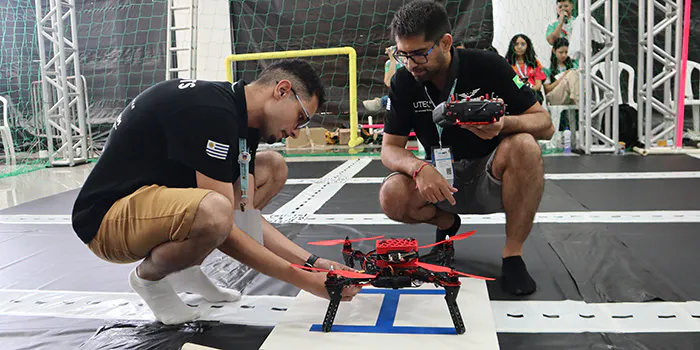
On the right sleeve of the black shirt is the flag of Uruguay, on the left the Brazilian flag. On the chest, on one side is the vulture symbol that represents them, on the other, the UTEC logo. The UTEC Norte robotics team, known as Urubots, represented both Uruguay and the Rivera-Livramento border in the FIRA RoboWorld Cup (the world cup of the International Federation of Robosports Association), which took place in São Luís do Maranhão. The group, which was formed in 2022, is made up of young people from the northern region of Uruguay and the south of Brazil who study different careers at UTEC Rivera.
Last year they had their first international competition in Germany, where they won a first prize in the Mission Impossible category. This year, the team went for more and entered four categories: Mission Impossible, Drones, Autonomous Cars and Humanoids. Despite their lack of experience in these disciplines, they managed to occupy the podium again with third places in Autonomous Cars and Humanoids. In the competition, the Urubots competed against teams from China, Taiwan, Canada and the Philippines, among others.
Ricardo Grando, the teacher in charge of the team, indicated that having participated in four categories and with 21 people in charge was a challenge that required a long preparation. "When we decided to participate, I set myself the goal of qualifying for the four main categories of the competition. That involves presenting papers, videos of the robots in operation, etc. We managed to qualify and, in addition, have a good participation. We learned technical knowledge and gained a lot of life experience in situations that only happen when you are traveling and working in a group," he commented.
The UTEC Robotics team, Urubots, at the Fira Roboworld Cup in Sao Luis do Maranaho
The cultural and technical exchange with other teams was another aspect highlighted by the members of Urubots. The competition featured teams from 22 countries and from all the states of Brazil. "It was a very difficult competition, a very competitive category. Even though we didn't win a prize in this category, we were able to learn a lot from the exchange with teams like the Philippines, especially how to solve problems in an ingenious way in a short period of time," added Ahilén Mazondo, a participant in the Mission Impossible category.
Victor Castelli, who was part of the Humanoids team, emphasized the importance of teamwork. "We had many challenges, but we managed to overcome them by working together. We went with a robot that had no spare parts, and already in the first practice there, one of our motors broke. That day we were up until 3:00 in the morning trying to take apart one motor to put together another, and we were competing at 9:00 in the morning. Then, as the days went by, two more motors broke, and I thought 'we're not going to make it to the final.' But by mixing the three broken motors together, we managed to put one back together and we made it to the final and got third place. It was very gratifying to see that we didn't give up. The other thing we learned is that even though we have fewer resources than other teams, we can make up for it with our talent," said Victor.
Victoria Saravia, a member of the group who participated as a coach, highlighted the fighting spirit of Urubots: "I want to highlight the enthusiasm of the team and the desire to learn from day zero. That is what is important, how a group of people, who may not know much about robots yet, strive to learn and put Uruguay in a place in this competition."
Members of the Urubots team at the Fira Roboworld Cup in Sao Luis do Maranaho
Finally, the director of the UTEC Regional Technological Institute North, Felipe Fajardo, congratulated the team for its performance. "We know that we do not have the ideal conditions, both in terms of budget and comfort for traveling, as well as infrastructure for training. Perhaps it does not compare with the equipment that teams from other places in the world have. But everything they achieved is the result of that motivation that is what leads them to always be working in the laboratory, every day and even on weekends" Fajardo pointed out.
The delegation was made up of 19 students and three teachers. The trip took them more than a day. The first stage of 1,200 kilometers, from Rivera to the city of Curitiba, was done by bus with the support of the Santana do Livramento Campus of the Federal Institute of Education, Science and Technology of South Rio Grande (IFSul). The remaining 3,300 kilometers were by plane. To cover the costs of the trip they had the support of the Ministry of Education and Culture; the Ministry of Industry, Energy and Mining; the Departmental Government of Rivera, Plan Ceibal and several courses of the UTEC Regional Technological Institute North.
Now the team has its sights set on qualifying for the FIRA RoboWorld Cup 2025 that will be in South Korea.